








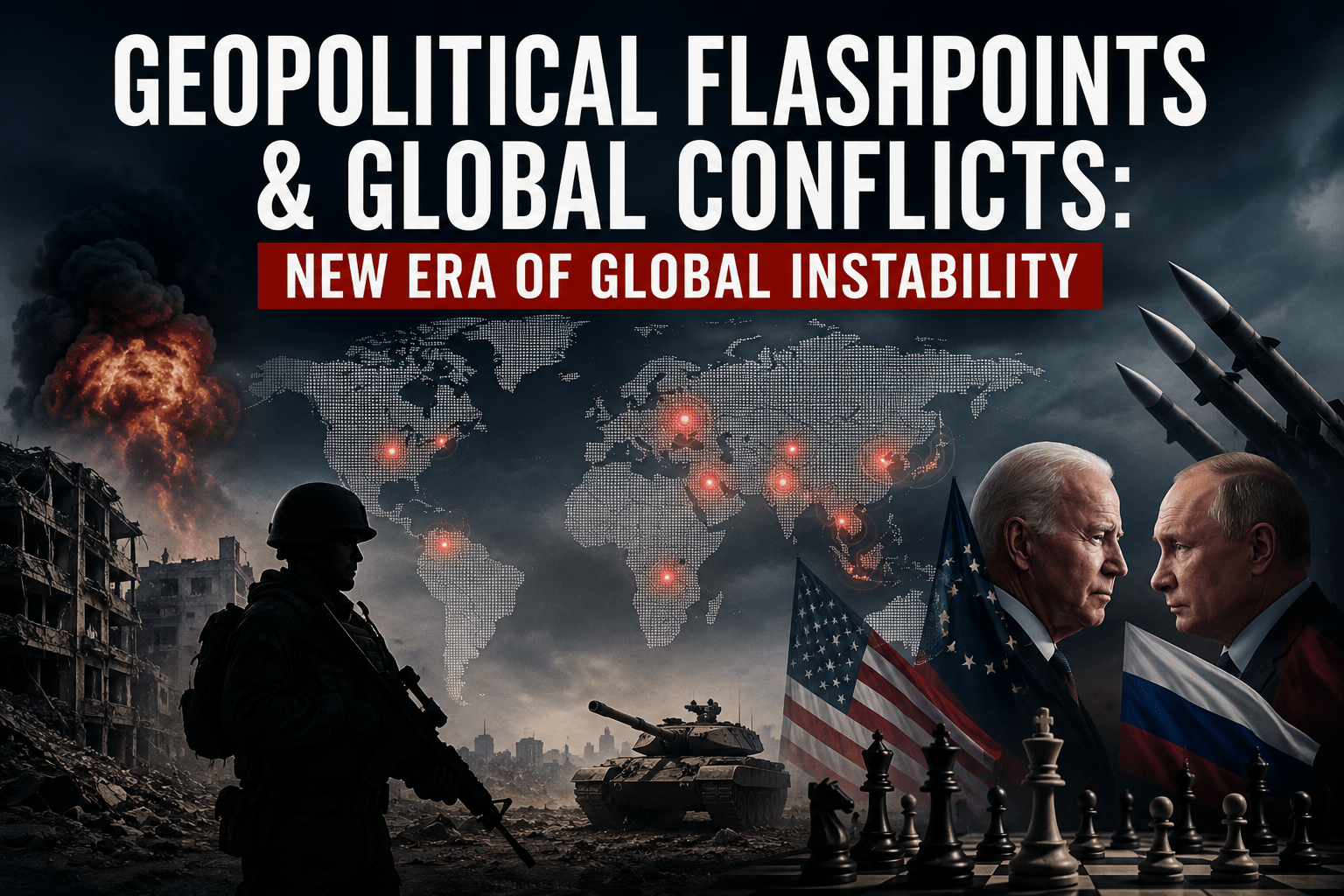
We are currently witnessing a new era of global instability; understanding these geopolitical flashpoints is no longer just an academic exercise, one defined by the breakdown of the post-Cold War order and a shift toward a more fragmented, multipolar world. Unlike the conflicts of the past, today’s risks are deeply interconnected driven by a mix of intense economic competition, a race for critical resources, and the rapid pace of technological change.
Global powers are now frequently using trade policies and sanctions as tools of influence, while long-standing military flashpoints in Europe, the Middle East, and the Indo-Pacific remain constant sources of tension. Adding to this volatility are emerging threats like cyber warfare and climate-related crises, which make it much harder for nations to cooperate on global challenges.
As traditional international institutions struggle to keep up, the world is becoming increasingly transactional and unpredictable, leaving us to navigate a complex environment where the line between peaceful competition and open conflict is thinner than ever.
1. The Anatomy of Modern Conflict: Why the World is Fracturing
We are currently witnessing a new era of geopolitical instability, one defined by the breakdown of the post-Cold War order and a shift toward a more fragmented, multipolar world. Unlike the conflicts of the past, today’s geopolitical risks are deeply interconnected driven by a mix of intense economic competition, a race for critical resources, and the rapid pace of technological change.
Global powers are now frequently using trade policies and sanctions as tools of geopolitical influence, while long-standing military flashpoints in Europe, the Middle East, and the Indo-Pacific remain constant sources of geopolitical tension. Adding to this geopolitical volatility are emerging threats like cyber warfare and climate-related crises, which make it much harder for nations to cooperate on global challenges.
As traditional international institutions struggle to keep up, the world is becoming increasingly transactional and unpredictable, leaving us to navigate a complex geopolitical environment where the line between peaceful competition and open conflict is thinner than ever.
The current wave of global instability is not a series of isolated events. Rather, it is the symptom of a structural shift from a unipolar world (dominated by the United States) to a multipolar world, where several major powers vie for sphere-of-influence dominance.
Several systemic drivers are accelerating this friction:
-
The Weaponization of Interdependence: Supply chains, energy pipelines, and financial networks once thought to be bonds that would prevent war are now being used as leverage.
-
The Decay of International Institutions: The UN Security Council and other regulatory bodies increasingly face gridlock, leaving a vacuum where might often dictates right.
-
The Technological Arms Race: The race to dominate Artificial Intelligence, semiconductor manufacturing, and quantum computing has turned commercial technology into the ultimate national security frontier.
2. Primary Flashpoints Reshaping the Global Order
The Indo-Pacific: The Epicenter of Great Power Rivalry
The Taiwan Strait and the South China Sea remain arguably the most critical flashpoints on earth. A localized conflict here would not just be a regional crisis; it would instantly paralyze the global economy.
Taiwan produces over 60% of the world’s semiconductors and over 90% of advanced microchips. A blockade or military confrontation would cost the global economy an estimated $10 trillion roughly 10% of global GDP dwarfing the economic fallout of recent conflicts. Furthermore, maritime disputes in the South China Sea involve critical trade arteries through which trillions of dollars in cargo pass annually.
Eastern Europe: The War of Attrition and Regional Spillover
The protracted conflict in Ukraine has fundamentally altered European security architecture. Beyond the immediate devastation, this theater has forced a massive rearmament across NATO member states and solidified a dangerous, counter-Western alignment between Russia, China, Iran, and North Korea.
The strategic risk here lies in miscalculation. As Western alliance systems deepen their logistical and intelligence support, the thin line between proxy warfare and direct, cross-border confrontation remains a constant anxiety for global strategists.
The Middle East: The Proxy Network and Energy Chokepoints
The Middle East remains a volatile matrix of state and non-state actors, where localized skirmishes rapidly escalate into international crises. The persistent vulnerability of maritime chokepoints specifically the Strait of Hormuz and the Bab al-Mandab Strait (the gateway to the Red Sea) means that regional instability instantly translates into spikes in global shipping costs and energy prices.
When non-state actors utilize low-cost drones to disrupt multi-billion-dollar commercial shipping lanes, it highlights a stark reality: asymmetric warfare can hold global trade hostage.
[Global Shipping Chokepoints under Geopolitical Stress]
1. Strait of Hormuz (Middle East Energy Arteries)
2. Malacca Strait (Indo-Pacific Trade Gateway)
3. Bab al-Mandab / Red Sea (Suez Canal Access)
3. The Secondary Risks: Resource Nationalism and Cyber Warfare
While kinetic warfare dominates the headlines, the invisible fronts of modern conflict are equally destabilizing.
The Scramble for Critical Minerals
The transition to clean energy has triggered a fierce geopolitical scramble for critical minerals like lithium, cobalt, nickel, and rare earth elements. Countries are increasingly turning to resource nationalism restricting exports to secure domestic supply chains. Because China controls the vast majority of the processing capacity for these materials, Western nations are scrambling to “friend-shore” or bring processing capabilities back within allied borders, creating a bifurcated global market.
Gray-Zone and Cyber Operations
We are permanently living in a “gray zone” the space between peace and open war. State-sponsored cyberattacks targeting critical infrastructure (power grids, financial institutions, and healthcare systems) have become a standard tool of statecraft. These operations offer deniability while inflicting massive economic damage, blurring the lines of what constitutes an act of war.
4. Strategic Implications for Global Business
In this fractured environment, operating a multinational enterprise requires an entirely new playbook. The era of optimizing supply chains purely for cost is over; the era of optimizing for redundancy and resilience is here.
-
From “Just-in-Time” to “Just-in-Case”: Companies are diversifying their manufacturing bases away from single-source dependencies. Countries like India, Vietnam, and Mexico are benefiting heavily from this shift.
-
Geopolitical Risk Insurance: Evaluating political risk, regulatory shifts, and currency volatility caused by sanctions is now a permanent fixture of C-suite boardrooms.
-
De-risking vs. Decoupling: While complete economic decoupling between major powers is nearly impossible due to deeply integrated markets, targeted “de-risking” in sensitive sectors (defense, tech, biotech) is actively accelerating.
Conclusion: The Road Ahead
Geopolitical flashpoints are no longer temporary disruptions to an otherwise stable system; they are the system. The coming decade will likely be characterized by persistent volatility, localized conflicts with global economic ripples, and a continuous realignment of alliances.
For forward-thinking organizations and leaders, survival does not depend on predicting exactly where the next spark will ignite. It depends on building agile, adaptable structures that can withstand the shockwaves when it inevitably does. True strategic foresight lies in accepting that peace is a variable, but geopolitical risk is a constant.