






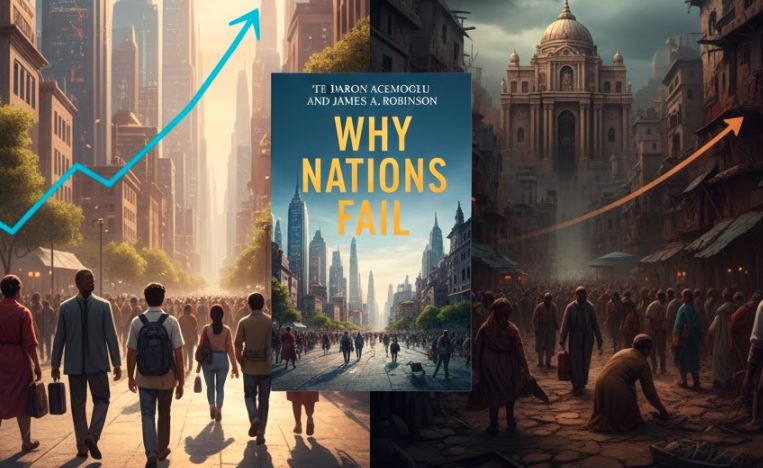
Written By: Ahmad Jawad Janjua

- Daron Acemoglu: A Turkish-American economist and the Elizabeth and James Killian Professor of Economics at the Massachusetts Institute of Technology (MIT).
- James A. Robinson: A British-American economist and political scientist who serves as a University Professor at the University of Chicago.
- 2024 Nobel Prize: Acemoglu and Robinson were jointly awarded the Nobel Memorial Prize in Economic Sciences in 2024 (alongside Simon Johnson) for their research into how institutions form and affect a nation’s prosperity. “Why Nations Fail”
- Central Thesis: The book argues that the success or failure of nations is determined by their “inclusive” or “extractive” political and economic institutions rather than by geography, climate, or culture. “Why Nations Fail”
-
Role of Institutions
Institutions are the rules, laws, and structures that govern political and economic life. The book divides institutions into two main types:
- Inclusive Institutions
- Extractive Institutions
Inclusive institutions create opportunities for broad participation in economic activities, protect private property, enforce the rule of law, and encourage innovation and education. These institutions empower citizens and foster economic growth.
Extractive institutions, on the other hand, concentrate power and wealth in the hands of a few, exploiting the majority for the benefit of the elite. They stifle innovation, limit economic incentives, and perpetuate poverty.
-
Economic Institutions and Growth
Countries with inclusive economic institutions allow individuals to pursue entrepreneurship, invest in new technologies, and participate in markets. This leads to higher productivity, more job creation, and sustained economic development.
In contrast, extractive institutions discourage participation, block competition, and limit incentives to innovate. This traps nations in cycles of poverty and dependence.
-
Political Institutions Shape Economic Outcomes
The book emphasizes that inclusive economic institutions require inclusive political institutions. A concentration of political power in a small elite often leads to extractive economic systems. Broad political participation ensures that institutions serve the majority rather than just the elite.
Historical examples illustrate this point:
South Korea vs. North Korea same geography and culture, but differing political and economic institutions led to dramatically different outcomes.
Colonial Latin America vs. North America extractive institutions in Latin America produced long-term inequality and poverty, whereas inclusive institutions in North America promoted innovation and growth.
-
The “Virtuous” and “Vicious” Circles
Acemoglu and Robinson describe feedback loops:
- Virtuous Circle: Inclusive institutions reinforce themselves, creating more opportunity, innovation, and political accountability.
- Vicious Circle: Extractive institutions reinforce inequality and power concentration, blocking progress and development.
-
Key Takeaways: “Why Nations Fail”
Inclusive political and economic institutions are the foundation of prosperity.
- Extractive institutions cause stagnation, inequality, and failure. “Why Nations Fail”
- Geography or culture alone does not determine a nation’s success.
- Historical events matter, but institutional structures largely explain why nations diverge economically.
The central message is that nations fail not because of bad people or culture, but because of extractive institutions that prevent the majority from accessing opportunities. Reforming institutions is the key to breaking cycles of poverty and achieving sustained development. Read More