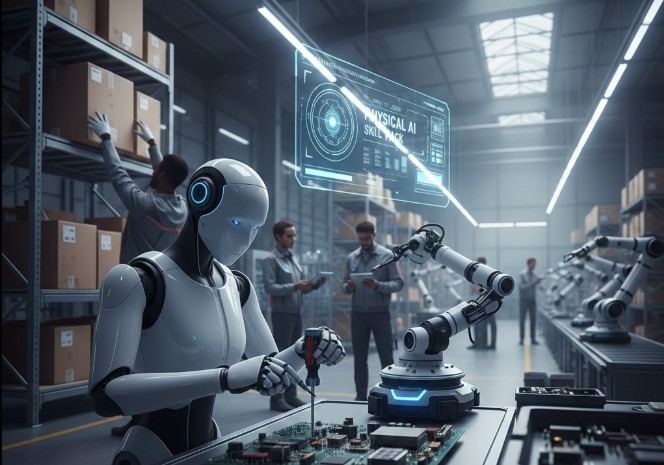
For years, Artificial Intelligence was a “brain without a body.” It could analyze spreadsheets, write poetry, and generate images, but it remained trapped behind glass. As we move into the second half of 2026, that limitation has vanished. We are witnessing the rise of Physical AI (also known as Embodied AI), the fusion of advanced neural networks with high-performance robotics to create machines that can perceive, reason, and act in the real world.
For the TechBullion audience, this represents the most significant shift in industrial history since the assembly line. We are moving from “automation” (robots that do exactly what they are told) to “autonomy” (robots that figure out what to do).
What is Physical AI?
Physical AI is the technology that enables a machine to understand the laws of physics, spatial geometry, and tactile feedback. Unlike the rigid industrial robots of 2020, Physical AI systems are powered by Vision-Language-Action (VLA) models.
These models allow a robot to:
-
See: Use multimodal computer vision to identify objects, even in messy or unorganized environments.
-
Understand: Process natural language instructions like “Pick up the fragile box and place it on the top shelf.”
-
Act: Coordinate complex motor skills such as the “fine motor” movements needed to turn a screwdriver or sort delicate electronic components without being explicitly programmed for every millimeter of movement.
The 2026 Market Landscape: From Pilots to Production
The market for Physical AI has exploded, with 2026 being cited as the “Year of Mass Deployment.” Recent data indicate the global Physical AI market is on track to grow at a CAGR of over 34%, driven by acute labor shortages and the need for supply chain resilience.
1. The Logistics Revolution: Beyond the Conveyor Belt
In 2026, the “Lights-Out” warehouse is becoming a reality. Physical AI enables Mobile Manipulator robots that combine a moving base with a dexterous arm to navigate busy warehouse floors autonomously. Unlike previous generations, these robots don’t need magnetic strips on the floor; they use LiDAR and SLAM (Simultaneous Localization and Mapping) to navigate around human workers and obstacles in real-time.
2. Humanoid Robotics: The “General Purpose” Worker
While specialized robots handle specific tasks, 2026 has seen the first commercial deployments of General-Purpose Humanoid Robots. Companies like Boston Dynamics, Tesla, and Figure are now delivering units to automotive plants and logistics hubs. These robots are designed to fit into environments built for humans, climbing stairs, opening doors, and using tools,s eliminating the need for expensive facility redesigns.
3. Smart Manufacturing and “Software-Defined Factories.”
Manufacturing is shifting toward the Software-Defined Factory (SDF). In these 2026 facilities, the hardware is standardized, but the “skills” are downloaded. If a factory needs to switch from making car parts to medical devices, it doesn’t need to be re-tooled; it simply uploads a new “Physical AI Skill Pack” to its robotic fleet.
The Challenges of “Contact-Rich” Tasks
Despite the progress, 2026 has highlighted the “Sim-to-Real” gap. It is easy to train a robot in a digital simulation where physics are perfect; it is much harder to operate in a “contact-rich” environment where things are slippery, dusty, or unpredictable.
Key hurdles being solved in 2026 include:
-
Tactile Sensing: Giving robots “digital skin” that can feel pressure and texture, preventing them from crushing a lightbulb while trying to unscrew it.
-
Edge Compute Density: Robots need massive processing power to run VLA modeon boardard. This is driving a boom in specialized Robotics-specific NPU (Neural Processing Unit) hardware.
-
Safety & Liability: As robots move out of cages and work alongside humans, the 2026 regulatory focus has shifted to “Collaborative Safety Standards,” ensuring that a robot’s AI can predict and avoid human movement with 99.999% reliability.
Business ROI: The “Robotics-as-a-Service” (RaaS) Model
For mid-sized businesses, the high capital cost of Physical AI was once a barrier. In 2026, the Robotics-as-a-Service (RaaS) model has matured. Companies now “rent” robotic labor by the hour or by the task, moving robotics from a CapEx (Capital Expenditure) to an OpEx (Operating Expenditure). This allows even small-scale manufacturers to compete with global giants on efficiency.
Conclusion: The New Industrial Infrastructure
Physical AI is the bridge that finally connects the digital revolution to the physical economy. In 2026, the most successful companies are those that view their robots not as “equipment,” but as an “intelligent workforce.” The transition from code to contact is no longer a futuristic dream; it is the foundation of the 2026 global supply chain. Read More