Written By: Abdul Aziz
I remember picking up Train to Pakistan for the first time, expecting a standard historical novel, something full of dates, political speeches, and dry facts about the 1947 Partition. Instead, I found a story that felt like a punch to the gut. It didn’t feel like I was reading about the past; it felt like I was standing on the station platform in Mano Majra, watching a world I recognized slowly turn into a nightmare.
Even though it was written way back in 1956, Khushwant Singh’s masterpiece remains one of the most compelling accounts of that era. Most history books focus on the “big names”—Jinnah, Nehru, or Mountbatten—but Singh does something different. He takes us to a tiny, fictional border village where Sikhs and Muslims had lived as neighbors for centuries, and shows us how that world just… fell apart.
The Heartbeat of Mano Majra “Train to Pakistan”
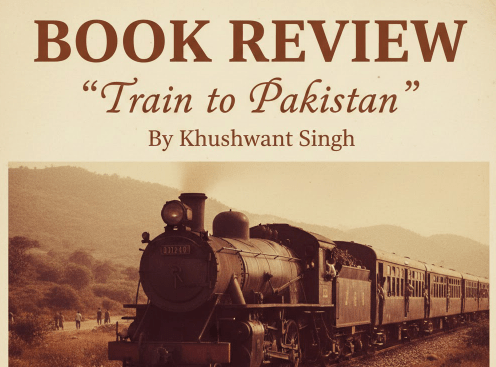
At the beginning of the novel, life in Mano Majra revolves entirely around the railway station. The trains are the heartbeat of the town; the morning mail train is the village alarm clock, and the evening passenger Train to Pakistan tells everyone it’s time to head home. This routine represents the “old India”—a place where religious identity existed, but it was secondary to the shared rhythm of daily life. People weren’t “Sikhs” or “Muslims” first; they were farmers, neighbors, and friends.
But as Partition takes hold, the trains change. They stop being symbols of progress and start becoming “ghost trains.” One of the most chilling moments in the book is when a train arrives from Pakistan in total silence. There are no whistles, no passengers climbing out, only the smell of burning wood and the horrifying realization that every soul on board has been massacred. Singh uses this image to show how quickly a community’s peace can be poisoned by external fear and suspicion.
A World Without Heroes
What I find most striking about Singh’s writing is his refusal to create “perfect” heroes. The characters are messy, flawed, and deeply human.
Take Jugga, for example. He’s a local dacoit (a bandit) and a criminal in the eyes of the law. He’s huge, violent, and uneducated. Yet, in the end, he is the only one with enough guts to perform a truly selfless act of courage. His motivation isn’t a grand political ideology; it’s his love for Nooran, a Muslim girl. Through Jugga, Singh suggests that real morality doesn’t come from a clean record or a higher education—it comes from a basic human connection that refuses to be broken by a border.
Then you have Iqbal, the educated social worker who comes to the village to “enlighten” the masses. He talks a big game about revolution and social justice, but when the violence actually starts, he is paralyzed by his own intellect. He’s too busy analyzing the situation to actually help anyone. It’s a biting critique of the intellectual class people who understand the “whys” of a tragedy but fail to act when it matters most.
And we can’t forget Hukum Chand, the regional magistrate. He is perhaps the most tragic character because he sees the disaster coming and knows he is powerless to stop it. He represents the moral exhaustion of the government, a man trying to maintain a sense of order while his own conscience is rotting away.
The Shared Burden of Guilt
One of the reasons this book remains so controversial and powerful is that Singh refuses to take sides. He doesn’t point fingers at just one group or religion; he is very clear that everyone was caught in the madness. As he famously observed:
”Both sides killed. Both shot and stabbed and speared and clubbed.”
By refusing to sanitize the violence, Singh forces us to confront a hard truth: Partition wasn’t just a political mistake; it was a collective human failure. He describes the massacres, the forced migrations, and the moral collapse with a clinical, almost documentary-like realism. There is no “pretty” prose here because the subject matter doesn’t allow for it. By keeping the language simple and direct, the tragedy of lost homes and shattered families feels much more personal.
Why We Still Need to Read Train to Pakistan
Ultimately, Train to Pakistan is a warning. It shows how easily fear and political manipulation can turn neighbors into enemies in a matter of days. It reminds us that when we stop seeing people as individuals and start seeing them only as “the other,” we lose our own humanity.
Decades later, that message feels unfortunately relevant. We still live in a world where borders are being redrawn, and communal tensions are being stoked for political gain. Singh’s work is a reminder that history isn’t just about maps and treaties, it’s about the ordinary lives that get caught in the middle.
If you haven’t read it yet, be prepared. It isn’t an easy read, and it won’t leave you feeling “good.” But it will leave you feeling more human, and in today’s world, that might be the most important thing a book can do. Read More Book Reviews