





Reviewer: Arslan Ali
Bio: IR Scholar at the School of Politics and International Relations, Quaid-i-Azam University, Islamabad.
Purpose: Chapter Review
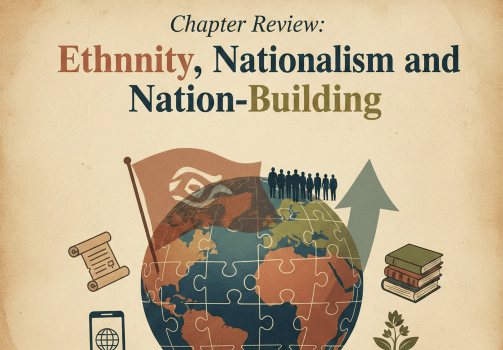
Chapter Name: Ethnicity, Nationalism, and Nation-Building
Book: State and Civil Society in Pakistan
Author: Ifhthikar H. Malik
Ifhthikar H. Malik Reviews on Ethnicity, Nationalism and Nation-Building
Iftikhar H. Malik critically explains how ethnicity and nationalism have shaped politics and nation-building in Pakistan. He shows that the state has often misunderstood ethnic diversity and treated it as a danger instead of accepting it as a social reality. Rather than seeing ethnicity as a natural part of society, the ruling elite and religious leadership have frequently viewed it as a threat or a foreign conspiracy.
The state promoted religious unity as the main basis of national identity while ignoring cultural, social, and economic differences. He also discusses ethnic conflicts, focusing on Sindh, the rise of ethnic movements such as the MQM in the mid-1980s, and the wider global debate on ethnicity and nationalism.
Pakistan’s ruling elite class largely rejecnic diversity and relied on short-term and force-based solutions instead of addressing genuine political and economic grievances. Ethnicity was not only political but deeply connected to culture and economic conditions, including demands for provincial autonomy, decentralization and fair treatment. These demands were repeatedly ignored by the central state.
The separation of East Pakistan in 1971 clearly demonstrated the failure of this approach but till now the st, ate did not learn from that experience and continues to treat ethnic identity as a security problem rather than a governance issue.
Sindh, once known for peaceful coexistence, became a major center of ethnic violence from the mid-1980s. Tensions between Muhajirs, who were Urdu-speaking migrants, and Sindhis increased rapidly. Police actions often worsened the situation instead of controlling it. The Afghan war contributed to the spread of weapons, strengthening militant ethnic groups. Cities such as Karachi and Hyderabad experienced urban guerrilla warfare. Atomic Habits By Tech Wingle
Benazir Bhutto’s Governments Struggle
Benazir Bhutto’s governments struggled to manage the crisis and the military remained reluctant to become deeply involved in ethnic conflicts. After the termination of her government in 1990, new political alliances emerged including Jam Sadiq, Ali’s alliance with the MQM, and anti-PPP forces. The MQM became extremely powerful in urban Sindh but relied heavily on violence and pressure.
A military operation in 1992 weakened the party temporarily, but ethnic tensions and internal splits increased. Although the MQM boycotted national elections in 1993, it performed well in provincial elections, reflecting strong Muhajir support. Karachi suffered from bombings, targeted killings, and ethnic cleansing, particularly against non-Urdu speakers. The army’s withdrawal in 1994 further worsened the situation, and the government lacked a clear plan to restore peace.
In rural Sindh, the PPP remained dominant, while Sindhi nationalists reassessed their position and increasingly viewed MQM-led violence as a greater threat. Ifhthikar Malik explains that many children of refugees born after 1947 continued to identify as Muhajirs even though they had not migrated themselves.
They rejected labels such as Sindhi or Panahguzeen because they considered them temporary. Their political identity developed mainly through the MQM while avoiding open ethnic labels. Ethnic identity, Ifhthikar Malik argues, is not fixed and can change over time. Bengalis shifted from a Muslim identity during colonial rule to Bengali nationalism after independence,e just aUrdu-speakingng migrants adopted a Muhajir identity after many years of calling themselves simply Pakistanis.
The author also places Pakistan’s experience within a broader historical and theoretical context. Some scholars argue that nationalism began in the West and later spread elsewhere, while others, such as Benedict Anderson, describe nations as “imagined communities” formed through shared stories, symbols, and media. Earlier societies were united mainly by religion and sacred languages.
Modern nationalism developed with local languages, capitalism, secular states, and territory-based identities. In colonized societies, anti-imperial nationalism emerged first but was later challenged by ethnic nationalism. Ethnicity is usually cultural and social, while nationalism
seeks political authority. Most states are multi-ethnic, yet many attempt to enforce unity through ethnic sameness, often with negative results.
Experiences of the Soviet Union
The experiences of the Soviet Union and Yugoslavia illustrate how efforts to suppress ethnic diversity ultimately failed as ethnic and religious identities re-emerged strongly after 1989. In democratic systems, ethnic diversity can strengthen civil society, while authoritarian systems treat it as a threat. Long-term unity depends on agreement, inclusion, and participation rather than repression. In South Asia, some scholars argue that Muslim nationalism emerged from fear of losing dominance, but this view ignores internal diversity.
Muslim identity was closely tied to religion and became politically significant, especially after the 1857 revolt, which intensified the Muslim identity crisis. Leaders such as Sir Syed Ahmad Khan, Iqbal, and Jinnah reshaped Muslim identity into a national one. Jinnah viewed Muslims as a separate nation rather than a religious minority within India.
Final Words
Pakistan was imagined as culturally Muslim but not a theocratic state and as a pluralist society for all citizens. Muslim nationalism was intended to be inclusive and cultural rather than extremist or anti-Hindu. Jinnah envisioned Pakistan as aa majority-Muslimcountry with protected minority rights and a strong commitment to pluralism. However, Pakistan’s authoritarian political structure, repeated military rule, and centralized governance increased ethnic marginalization.
The promotion of Urdu as a national language and the dismissal of regional identities intensified resentment, particularly in Sindh and Bengal. Ifhthikar Malik concludes that without political, economic, and social reforms, ethnic tensions may grow and that greater democracy, decentralization, accountability, and dialogue are essential for equality and nation-building. Read More at Research Gate