










Written By: Hussain Baloch
Introduction
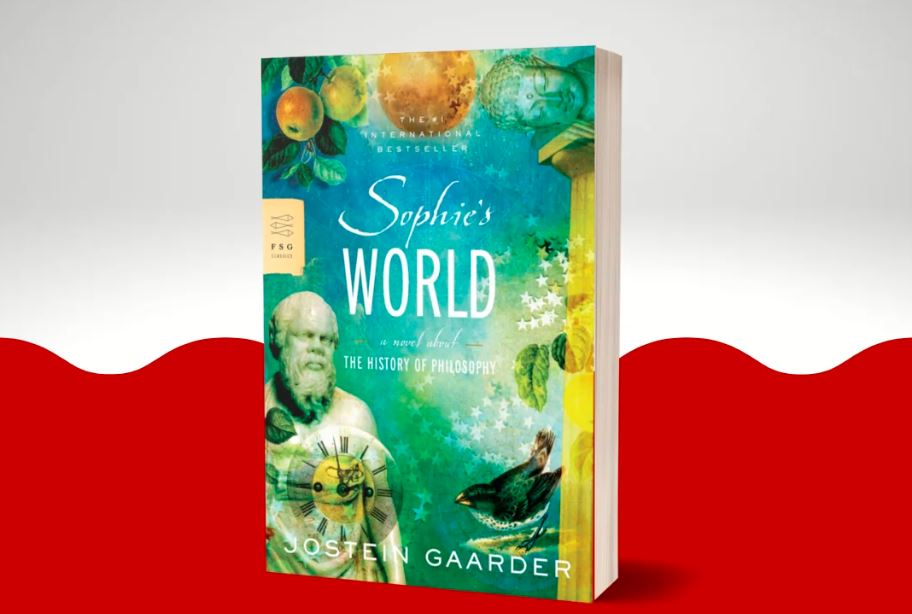
Sophie’s World is a famous philosophical novel written by Jostein Gaarder, a Norwegian author. First published in 1991, this book became popular all over the world because of its unique idea of teaching the history of philosophy through a story. It is not just a novel; it’s a journey that makes readers think deeply about life, existence, and the meaning of everything around them.
The main character is Sophie Amundsen, a 14-year-old girl who begins to receive mysterious letters from an unknown teacher. These letters contain simple yet powerful questions like “Who are you?” and “Where does the world come from?” These questions start Sophie’s adventure into the world of philosophy, and through her eyes, we learn about the great thinkers of history.
Plot Summary
The story begins in a quiet Norwegian town, where Sophie lives an ordinary teenage life. One day, she finds a strange letter in her mailbox asking, “Who are you?” Soon after, she receives more letters and starts a course in philosophy from a mysterious teacher named Alberto Knox.
As Sophie learns from Alberto, she explores the thoughts of great philosophers such as Socrates, Plato, Aristotle, Descartes, Kant, and Hegel. Each lesson opens her mind to new ideas about life, knowledge, reality, and human existence.
However, the story takes an unexpected turn when Sophie realizes that something strange is happening. She and Alberto seem to be characters in another person’s story, a girl named Hilde, whose father is writing the book for her. This twist adds mystery and depth, making readers question what is real and what is imaginary.
Themes and Ideas
The central theme of Sophie’s World is philosophy, the love of wisdom. But the book also explores many other ideas, such as curiosity, identity, free will, and reality.
Through Sophie’s journey, the author shows that philosophy is not something boring or only for old scholars. It’s something that belongs to everyone. Every person who has ever asked, “Why am I here?” is already a philosopher.
Another strong theme is the search for meaning. Sophie’s world changes completely when she starts to question everything she sees. This shows that real learning begins when we stop accepting things blindly and start thinking for ourselves.
Philosophy Made Simple
One of the most impressive things about this book is how Jostein Gaarder explains difficult philosophical ideas in a very simple way. The book covers the entire history of philosophy from the ancient Greeks to modern thinkers, but it never feels heavy or confusing.
The author uses storytelling to make learning enjoyable. When Sophie learns about Plato’s world of ideas or Aristotle’s logic, the reader learns along with her. It feels as if we are taking the same class with Sophie and Alberto. This creative teaching method makes philosophy come alive for the reader.
Characters
The characters in Sophie’s World are not just people; they represent ideas.
- Sophie Amundsen: She is curious, intelligent, and thoughtful. Through her eyes, the reader experiences the excitement of discovering new ideas. Sophie represents the human desire to understand the world.
- Alberto Knox: Sophie’s teacher and guide in philosophy. He explains history’s greatest ideas simply and interestingly. Alberto also becomes a symbol of wisdom and freedom of thought.
- Hilde Møller Knag: The girl who reads the story of Sophie. Her role connects the real and imaginary worlds of the book.
Major Knag: Hilde’s father and the writer of Sophie’s story. Through him, the author raises questions about creation, control, and free will.
Writing Style
Gaarder’s writing style is simple, clear, and full of curiosity. He uses short chapters, direct questions, and friendly language that make readers think deeply without getting bored.
He often connects big philosophical ideas to small, everyday moments like looking at a flower, a tree, or the stars. This teaches us that philosophy is not just about books and theories but about how we see the world.
The mix of letters, dialogues, and mysterious events keeps the story exciting from beginning to end.
Symbolism and Deeper Meaning of Sophie’s World
The novel has many symbolic meanings. Sophie’s world represents our own world full of questions and mysteries. The letters from Alberto symbolize knowledge and awakening, while Hilde’s story represents the idea that there may be a higher creator controlling everything.
The story within a story makes us question: What if our world is also someone else’s story? This idea connects directly to philosophy, which always tries to understand what is real and what is an illusion.
Personal Reflection
Personally, I found Sophie’s World to be an eye-opening book. It changed the way I look at things. Before reading it, I never thought deeply about where we come from or why we are here. But Sophie’s questions made me realize that these are the most important questions of life.
I liked how the book encourages readers to think independently instead of just accepting what others say. It also shows that learning should be joyful and full of curiosity. I felt like I was growing along with Sophie, discovering new ideas and questioning old beliefs.
Educational Value
This book is not only entertaining but also highly educational. It gives a complete overview of Western philosophy in a story form. Students who find philosophy difficult in textbooks can easily understand it through this novel.
It teaches important lessons about logic, reasoning, and critical thinking. It also inspires readers to keep asking questions because that’s how wisdom begins.
Conclusion
Sophie’s World is a masterpiece that combines storytelling with education. Jostein Gaarder has created a book that makes readers both think and feel. Through Sophie’s eyes, we learn that life is full of mysteries and that every human being has the power to think deeply about them.
The book teaches us to stay curious, to ask questions, and to never stop wondering about the world around us. It’s not just a novel; it’s a journey of the mind and soul. Anyone who reads it will come out a little wiser and more thoughtful than before. Read More Book Reviews