
Written By: Asra Ali
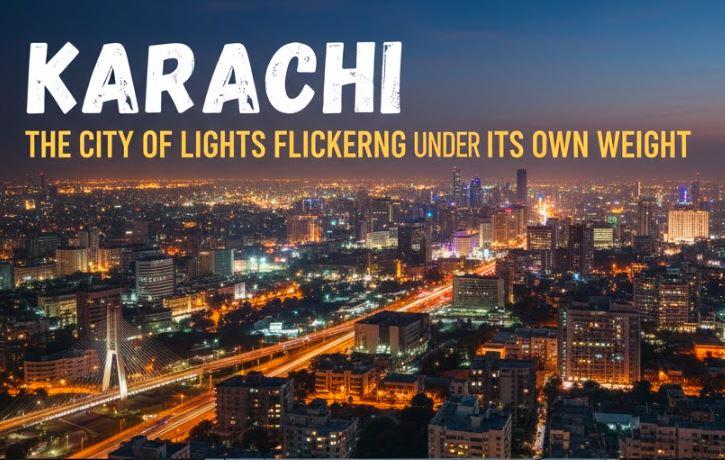
Once hailed as the “City of Lights,” Karachi now flickers under the shadow of its own collapse.
Where once bustling streets echoed with commerce and opportunity, today there is the murmur of clogged drains, fractured roads, and administrative confusion. Karachi, Pakistan’s largest metropolis, has always been more than a city; it is the economic heart of the nation, the gateway to trade, the stage for industry, and the home to millions who fuel the country’s growth. Yet today, despite its unmatched importance, it teeters on the brink of systemic dysfunction, where mismanagement, urban sprawl, and crumbling infrastructure threaten not only the city itself but the nation it serves.
Karachi is the backbone of Pakistan’s economy. It contributes nearly a quarter of the nation’s GDP, hosts two of the country’s busiest seaports, Karachi Port and Port Qasim, and handles more than half of Pakistan’s imports and exports. It is a city of industries, banks, textile mills, corporate offices, and financial markets. Its workforce is diverse, innovative, and resilient, driving cultural vibrancy and national mobility. Yet, decades of neglect, political interference, and short-sighted policies have steadily eroded its ability to function effectively. The city that once illuminated the nation’s economic potential now struggles to keep the lights on.
A City Crumbling from Within
The signs of Karachi’s decline are evident in every corner. Streets flood during monsoons, water is scarce, garbage piles up in public spaces, traffic crawls through clogged arteries, and the administrative system offers no coherent response. Each failure does not remain isolated; it reverberates across the nation, affecting commerce, industry, public health, and social stability. To understand the full impact, one must look at the forces driving this collapse.
Infrastructure and Flooding: The Water That Cannot Flow
Karachi’s drainage and sewerage systems, built decades ago, were never designed for the population it now serves. Every monsoon transforms the city into a quagmire, where residential areas, markets, and highways vanish under rising waters. Rivers like the Lyari and Malir have been blocked by unplanned construction, illegal encroachments, and waste, leaving water with no place to go. Floods halt commerce, damage property, and spread disease. They delay transport, disrupt supply chains, and shake investor confidence. What begins as a local inconvenience becomes a national economic strain. Infrastructure failure in Karachi is not just a city problem; it is a blow to Pakistan’s industrial output, trade efficiency, and human resilience.
Water Scarcity: The City Thirsts
While Karachi requires over a billion gallons of water daily, authorities fail to provide even two-thirds of this basic need. Leaky pipes, water theft, and poor management leave residents dependent on tanker services, often overpriced and unsafe. Factories, banks, and offices operate with an interrupted water supply, reducing productivity and raising operational costs. Families queue for clean water, children fall ill from contaminated supplies, and the poor bear the brunt of inequality as water becomes a commodity for those who can pay. In a city without reliable water, no business can thrive, no industry can expand, and no household can live with dignity. The city’s thirst is, in essence, a reflection of a nation denied a vital resource.
Waste and Environmental Decay: Garbage in Every Corner
Karachi generates thousands of tons of solid waste every day. Yet only a fraction is collected or processed. Streets overflow with garbage, drains clog, and rivers carry untreated sewage to the sea. The air thickens with smoke from trash burning and industrial emissions. Diseases rise, from dengue to cholera, asthma to skin infections. Tourism falters, fisheries decline, and global rankings label the city unlivable. Environmental neglect has transformed Karachi into a warning for the nation: when the city dies, the ecosystem, the economy, and the people pay the price.
Transport Gridlock: Hours Lost in Motionless Streets
Karachi’s transportation woes are well known. Public transit remains insufficient, overcrowded, and inefficient. The Karachi Circular Railway operates only partially, bus networks are outdated, and commuters flood the roads with private vehicles. Daily, citizens waste two to three hours in traffic. Productivity falls, stress rises, fuel is wasted, and accidents claim lives. Delays ripple through national supply chains, increasing the cost of goods and undermining Pakistan’s economic competitiveness. When Karachi’s streets halt, so too does the country’s momentum.
Governance and Administrative Fragmentation: No One at the Helm
At the core of Karachi’s crisis is governance failure. Multiple agencies, KMC, KDA, Sindh Government, and cantonments operate without coordination. Projects stall, funds are misused, and accountability is scarce. Political interference delays or distorts development. Even crucial projects like the K-IV water supply scheme face years of inaction due to poor planning and oversight. In a city where responsibility is divided, progress is fragmented, and the nation bears the cost. Karachi’s mismanagement is not a municipal issue; it is a national liability.
Ripples Across the Nation
Karachi’s dysfunction is not confined to city limits. Its effects radiate across Pakistan:
- Economic Slowdown: Disrupted transport, delayed ports, and struggling industries reduce productivity, drive up business costs, and weaken export competitiveness.
- Social Instability: Inequality, frustration, and insecurity rise among residents, increasing crime, unrest, and migration pressures.
- National Image: International investors judge countries by the condition of their major cities. Karachi’s decay signals weakness and deters investment.
- Public Health Costs: Polluted water, poor waste management, and environmental hazards increase healthcare burdens nationwide.
Karachi’s collapse, in essence, threatens Pakistan’s ability to compete regionally and globally.
Paths to Revival: Structured Reforms
While the situation is difficult, hope remains. The city can be revitalized through careful planning, transparent governance, and sustained investment.
- Empower Local Governance: A unified metropolitan authority should oversee water, sewage, transport, waste, and urban planning.
- Modernize Infrastructure: Clear encroachments, expand drainage and sewerage systems, and improve stormwater management.
- Reform Water Distribution: Upgrade pipelines, prevent theft, complete K-IV transparently, and involve public-private partnerships.
- Integrated Waste Management: Introduce recycling, modern landfills, composting, and strict penalties for illegal dumping.
- Public Transport Improvements: Expand mass transit, modernize existing systems, and reduce reliance on private vehicles.
- Transparency and Accountability: Implement public audits, citizen feedback platforms, and strict penalties for negligence or corruption.
With consistent and determined action, Karachi can reclaim its place as a functional, sustainable, and economically productive city.
The Heartbeat of a Nation
Karachi’s urban collapse is not a municipal failure alone; it is a national warning. The city’s decay disrupts trade, slows economic growth, undermines human development, and strains the environment. Yet Karachi can rise again. With structured reforms, empowered governance, and strategic investment, the city can restore its role as Pakistan’s economic engine.
The future of Pakistan is entwined with the future of Karachi. To revive this city is not optional; it is essential for the nation’s survival, progress, and prosperity.
Because when Karachi thrives, Pakistan thrives. When Karachi falters, the nation feels every tremor. And thus, the city’s fate is inseparable from the country’s own. Read More About Climate Change