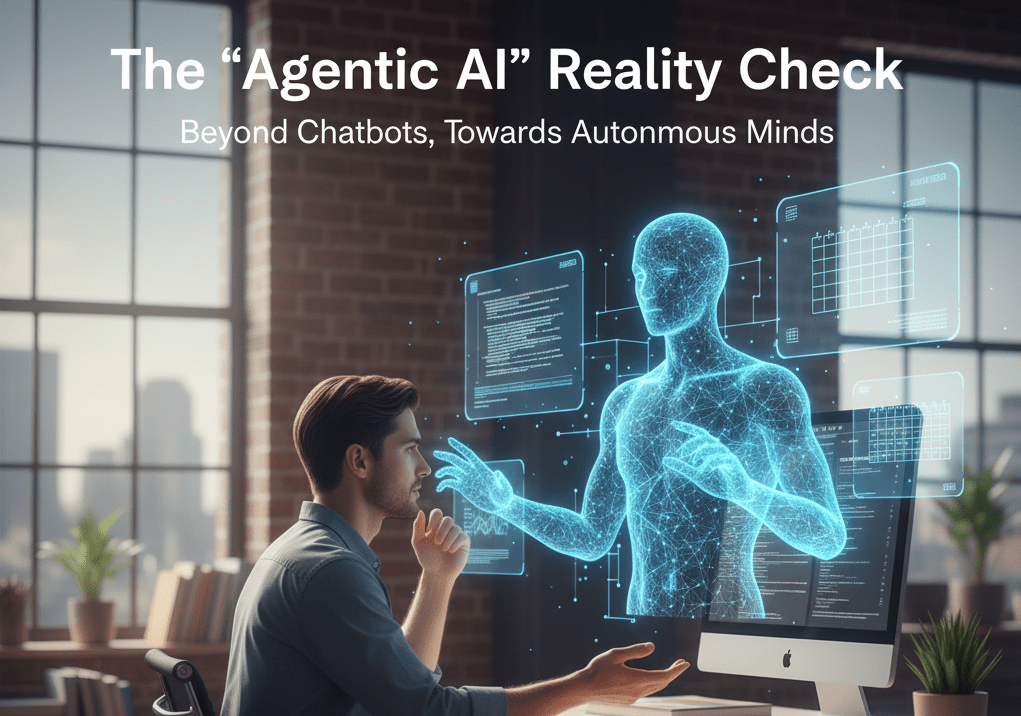
Over the years, the artificial intelligence promise has been that it will not only take away menial tasks but also be a tireless helper that responds to questions. The emergence of chatbot models called ChatGPT put AI in focus, but also exposed a paradox: tremendous intelligence, which is yet to have a real agency. We waste hours of our time provoking, directing, and perfecting AI work only to find that the solution to it, overcoming busywork, lies elsewhere, in Agentic AI.
As a technology community, 2026 is the year in which we are facing a reality check. The emphasis is radically moving away, however, not just to make AI, the AI that generates, but to the AI that acts, which is now known as Agentic AI. This is not just a semantic change; it is an indication of a far more radical change in ability that is set to revolutionise the way in which we work, learn, and, in fact, relate to technology. But what is Agentic AI, and is the reality as good as the hype?
“The Agentic AI” History of Artificial Intelligence Chatbots to Co-Pilots:
In a bid to get the true understanding of Agentic AI, we must acquire its lineage.
Generative AI (Stage ) distance: Think of a traditional chatbot. You make a query, such as writing an email requesting a meeting, and it responds to you. It is very strong, only it is completely reactive. It follows your order, carries it out, waits, and awaits your next order. You are the conductor; it has a one-stringed instrument.
Agentic AI (Stage 2): In this stage, the AI progresses further past generative to agentic action. An Agentic AI can comprehend a high-level objective, such as, Plan my next business trip to Singapore, and break those objectives down into smaller objectives, execute those objectives (booking flights, hotels, scheduling meetings), track the progress of its objectives, and correct itself in case of something going wrong. It is a co-pilot that is proactive, can think, and take action within specific limits.
Autonomy and goal-oriented behavior are the fundamental points of difference. An Agentic AI is more than a responder; it is an initiator. It designs, moves, and experiences what is in its surroundings and strives towards a pre-established goal using minimum human influence.
What an AI Agent looks like: Beyond the Code
The question is how an AI Agent realizes this new autonomy? It is not a one-dimensional rocket but a complex coordination of a few major elements:
planning module -The brain that separates complex goals into action steps. As an example, when the aim is to research the most effective marketing strategies of Gen Z, the planner can draw up the sequence:
- Find out the latest research about Gen Z consumer behavior.
- Find winning social media networks in Gen Z.
- Gen Z case studies Analysis. Summarize the results in a report.
Memory Module: The artificial intelligence agents remember information, unlike a stateless chatbot that would forget after a few interactions with the user.
Short-term memory retains the short-term context.
Long-Term Memory is a store used to store the learned experiences, previous knowledge, and previous successes or failures in order to help the agent improve with time.
Tool Use Module- this assigns the agent its hands. Agents are able to be incorporated with third-party applications, including web browsers, email software, calendar software, payment systems, and APIs, and thus can be configured to carry out tasks in the real world, like emailing, making reservations, or executing code.
A critical learning. Upon accomplishment of a task, an agent will consider the result: Was it the efficiency of the goal? Were there any unforeseen challenges? This reflection helps in future planning as well as future execution approaches.
Perception Module- This module is particularly applicable to physical AI interacting with the world. It is where sensory information, such as images, video, and audio, incoming through the environment, is interpreted.
The Hype vs. the Reality: Where Are We Now?
The 2024-2025 buzz about Agentic AI was enormous, and people could even imagine fully autonomous and sentient digital assistants in the near future. Although the rate of progress has been quite steep, the “reality check” approach in 2026 incorporates a more refined viewpoint:
The Progress: Software Development: AI agents are already capable of writing, debugging, and testing code with impressive efficiency. Agents are being used by the developers to automate the mundane coding activities and concentrate on the upper-level architecture.
Data Analysis: Financial analysts are implementing agents to survey the markets, to analyze the company earnings, and even to generate the trading signals depending on the set plans.
Personal Productivity: First mover agentic personal assistants are already being developed that can sort email inboxes, set up video conferences across time zones, and even write project reports using the data stored up to date.
Customer Service: Next-generation chatbots will become capable of answering customers, as well as troubleshooting technical problems, refunding customers, and even upselling products depending on customer history, without human intervention.
Reality Check Current Problems:
Safety & Control: Safety is still the biggest issue. Where do we provide an autonomous agent to act ethically, follow our principles, and avoid leaving tasks that may be harmful and irreversible? The first and foremost step involves defining clear guardrails and powerful kill switches.
Local Minimum: Although agents are more trustworthy than simple generative models, they cannot be guaranteed to avoid falling into one of two categories: “AI slop” – The production of low-quality, generic, or poorly factual text, or a hallucination – An actual hallucination. The more independent an agent is, the harder it is to audit its internal reasoning process.
Over-Optimization & the Law of Goodhart: Agents, as such, are goal-oriented. This may cause them to over-optimise on a particular measure at the cost of other, less measurable goals. When an agent receives the mandate of maximizing sales, it will perhaps inadvertently turn off customers or ruin the brand name in its ruthless quest to hit the target.
Complexity & Debugging: Complexity. This is the most complex task. When an agent goes wrong, it is a nightmare to debug what went wrong. The people can hardly interfere in its internal decision-making process, which can be opaque, and learn the lessons.
Cost of Compute: Implementing complex AI agents that continuously plan, analyze, and communicate to external systems is very costly in terms of computational resources, and personal agents that are fully featured and constantly available remain very expensive to the common individual.
The Future of Work: Co-Existence Model
The reality check ” Agentic AI” is not about setting the goals down to earth; it’s about streamlining them. We are heading to the future of AI co-existence, in which human beings and intelligent agents will work together.
Augmented Human Capabilities: It will not substitute humans on a wholesale basis but will augment our capabilities. They will deal with the less creative, time-intensive jobs so that humans can develop their creativity, critical thinking, strategy development, and sophisticated issues that demand empathy and subtlety.
Specialized Agents: There is specialized software, just as we shall have specialized AI agents. One can have a marketing agent to maximize efforts on campaigns, a legal agent reviewing contracts, and a medical agent to aid with diagnostics.
The HHHI: For the next few years to come, human supervision will be indispensable, particularly when delegating tasks that have high stakes. Agents will also make suggestions and implement under the oversight, as well as make the decision that needs to be made by a person.
Conclusion: The Agentic AI Future of the True Digital Assistants
The results of the reality check, Agentic AI of 202,6, state that the path to fully autonomous, trustworthy digital agents is far more complicated, but the destination has never been more obvious. We have left behind the time when we speak to AI; we are learning to cooperate with one that not only thinks, plans, and performs.
The shift from chatbots to co-pilots isn’t just a technological upgrade; it’s a redefinition of productivity and human-computer interaction. As these agents become more sophisticated, reliable, and integrated into our daily lives, they promise to unlock unprecedented levels of efficiency, innovation, and ultimately, free up valuable human potential to tackle the challenges that only we can truly solve. The future of AI isn’t just smart; it’s getting things done. Read about Physical AI