
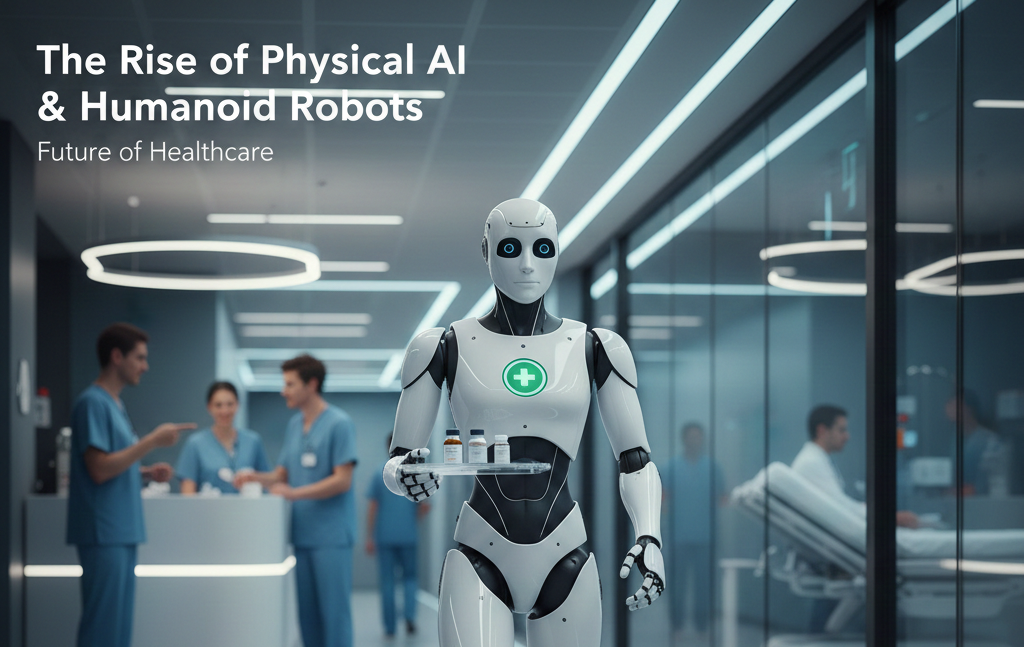
In the past few years, AI has been the kind of secret helper that has been inside phones and laptops. It can write poems, code, and create art. It is beginning to turn into real robots as we go into the year 2026.
Now it is the era of Physical AI. Big language models (LLMs) collaborate with robots with moving and handling capabilities. Artificial intelligence allows these robots to see, feel, and learn even when interacting with human beings.
What Exactly is “Physical AI”?
In order to perceive the difference, we must examine the current AI as compared to Physical AI. The regular AI, the Brain, operates with words and images. It can predict other words, but it does not comprehend gravity or the weight of things. The Body + Brain, physical AI, employs the models, which involve language, action, and vision. These conceptions become actual movements. When a Physical AI robot gazes at a glass of water, it not only knows it is a glass of water but also knows how firmly to grip it so that it does not break.
The Breakthrough of 2025: Lab to Living Factory.
Now, the day of December 22, 202,5, the subject is hitting the news as we are past the flashy demonstrations. The use of robots in real-life settings is now conducted on a large scale.
Industrial application: Battery company CATL introduced the Moz robot to work on high-voltage battery tests. The job is too dangerous for human beings and too difficult for programmed machines.
Prices are downward: Unitree and Agibot are both Chinese firms that produce cheaper robots. Some models are less expensive than 10000 dollars, and hence, small businesses can afford them.
Robot training: It is when companies simulate factories in virtual copies, which they call Digital Twins, and robots train on tasks in seconds before they begin. It used to take years before training came to weeks.
Why Humanoid? The World is Built for Us
What is the point in creating a robot that resembles a human? Wheels may sound like a better option, but it is easy enough. Our bodies were made into buildings, steps, door handles, and tunnels made by people. In case a robot is required to work in a hospital, a grocery store, or the house of an old person, it should be in a human form, because it should be able to move around in our places without changing significantly.
The Economic Shift: A 5-trillion Frontier?
Finance people care. Morgan Stanley estimates that the market for humanoid robots could reach 5 trillion in 2050. That is quite distant, but consequences are present.
Optimus and the Atlas of Tesla and Boston Dynamics will begin operating in shipping and automobile factories in 2026. It is not simply replacing the workforce but sealing the large labor shortage of the greying population in Europe, North America, and East Asia.
The Hallucination Problem: When AI Slams into a Wall.
But there’s a problem. ChatGPT hallucinates to provide misleading facts. When a Physical AI robot hallucinates, it may knock a shelf down or press on a human hand.
What the race is now concerned with is not only making the robots more robust, but also more secure. Phase Two implies improved touch sensors to allow the robots to feel, and edge computing to allow the robots to make a decision without relying on the help of a cloud.
Healthcare The Precision Caretaker
Physical AI does not substitute doctors in the context of health care. It assists in correcting the current shortage of employees.
Better than operation: Although there are also robotic arms such as the Da Vinci, there are new humanoid bots that perform such operations as carrying up supplies, laundry, transporting medicine to rooms, and maintaining sterility.
Patient monitoring: Doctors replicate a physical body of a patient to a virtual one via Digital Twins. They will be able to rehearse difficult surgeries on an ideal simulation before the actual surgery.
Construction: The End of The High-Risk Labor.
It is very hazardous and requires a high number of workers. The physical AI is rendering job places safer.
Remote control and training, Startups apply VLA models. A VR headset is used to control a robot by a person putting it on. The robot helps to monitor and gain knowledge on how to lay bricks or weld pipes independently.
Unstructured spaces: Moving objects. Construction robots must traverse mud, scaffolding, and debris transport, which factory robots are not required to do. It is just to create new humanoid bots made by Apptronik. They can transport materials and carry heavy weights, which is the cause of 80 percent of injuries to workers.
Retail: The Smart Storefront
Retailing is becoming a full robot experience as opposed to self-checkout.
Smart inventory: Humanoid robots are used to scan shelves in large shops in real time. They make sure that things are not misplaced or run out of stock at any given time, and therefore, customers do not see empty shelves.
Hyper-personalization: imagine visiting a shop, and a robot reminds you of what you have purchased previously and advises on what to buy. By the year 2026, the Agentic AI will allow the robots to offer you a special discount in case they notice that you are not sure.
Concluding Remarks: A colleague, not a Tool
A significant shift in the dynamics of interaction between people and technology characterizes physical AI. We are moving out of the mode of using the computers and into collaborating with them.
The distinction between computer brains and real bodies is becoming thin, whether a construction site is being checked by a robot dog or a humanoid assists in a surgery room. The future is not something on its way, but it is here.