










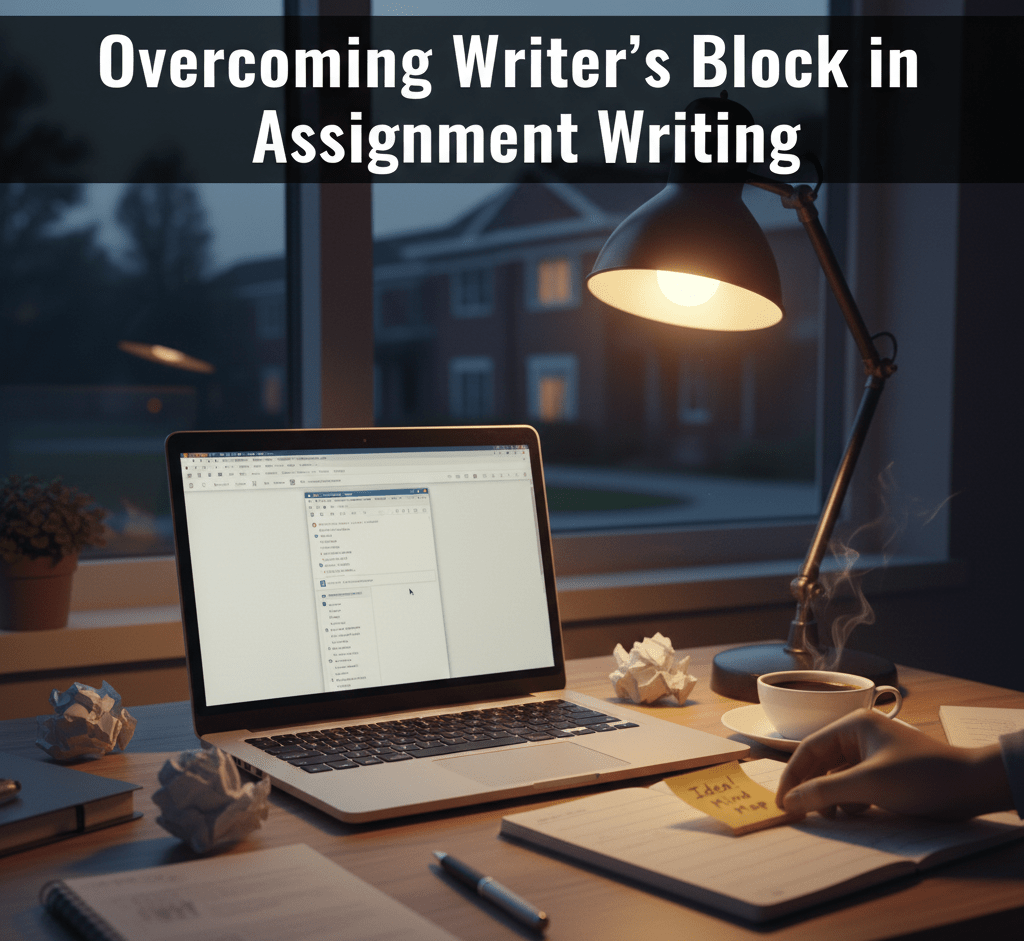
You sit down to start your assignment. You look through the topic and open a document and crack your knuckles to begin the writing part, and all of a sudden, your mind goes blank. You feel you can’t think of anything and push yourself to write down words, but it just doesn’t make sense. That’s writer’s block.
While the phenomenon may sound like a big mental disorder, it’s something common that every other student faces at some point of their academic life. If you’re going through any of the above scenarios, that doesn’t mean you’re incapable. That’s just your body’s way of responding to different emotions.
The good news? You can overcome it pretty easily with the right approach. So, if you can’t seem to fill your blank mind with creative ideas, this blog will help you out.
But before talking about the strategies, let’s address the elephant in the room: ”Why does it really happen.”
Why Writer’s Block Happens
Writer’s block creeps in when your mind is overloaded, uncertain, or simply overworked. It’s possible you’re trying too hard to get everything perfect, and not achieving it can bring your hopes down.
It often happens when you don’t completely understand the topic, and that’s why you don’t really know where to start.
Even phone notifications and constant distractions can kill your writing mood and leave you feeling like you don’t want to write anything. Other times, self-doubt is the killer of your creativity, and you end up with a blank mind that can’t come up with incredible ideas.
No matter the reason, don’t get frustrated and understand that’s a normal response from your body to tension.
When you go through the stuff, students often go for two things: either they take assistance from a professional essay writing service UK, or they buckle down and start looking for the reasons behind that mental block. We suggest you choose option 2 because we have compiled 6 proven methods to help you overcome your writer’s block.
Six Practical Strategies to Beat Writer’s Block
Below are six easy, proven ways to get your words and confidence flowing again.
- Break the Task into Smaller Steps
The writing dilemma usually strikes when you see a big task that seems impossible to complete. You look at the word count or the deadline, and instantly your brain decides, ”That’s not going to happen.’
If you face such an issue in the future and want to kick that out of your life, the trick is to stop seeing it as one giant task. Break it into small, achievable goals that are easy to hit.
Think of it like climbing stairs. You don’t need to jump to the top in just one attempt. Take your time and go for baby steps. Before you know it, you’ll find yourself at the end stairs. Similarly, begin by listing what needs to be done in the assignment and start working on it at regular intervals.
Wondering why? By finishing a small section, your mind gets the sense of winning and automatically wants to do better in the next one.
- Set a Writing Routine
Try to understand one thing: inspiration doesn’t always show up on time. That’s why you can’t just open your books in the middle of the night after having a complete blast at your cousin’s birthday and expect your mind to turn in something out of the box. That’s just not going to happen.
On the contrary, if you set up a routine and stick to it, the results will be magnificent. So, always get to work at a specific time, each day, when your mind is fresh. It doesn’t matter if it’s early morning or late at night; you just need to be focused.
It’s similar to brushing your teeth. When you do it regularly before going to bed, it doesn’t feel like a task but a part of your routine. Once your brain gets used to this pattern, writing comes naturally to you.
What happens next? The routine will help you get motivated to work. That consistent effort of 30 minutes dedicated to your studies can turn a blank page into a miracle of ideas, developed by your own mind.
- Start with a Brainstorm or Outline
What is the most challenging part of writing? It’s the beginning! If you sort that out, the rest will be like a piece of cake. To start off, you need to have a clear roadmap of what to do in the assignment. First things first: create an outline that highlights your approach to carrying your writing journey forward. That can easi;y be done by brainstorming.
Instead of jotting down complete sentences, start by listing down ideas and how you will unfold your argument on paper. Collect key points, questions that you must answer, and topics that should be justified.
When your thoughts flow freely, what you must do is gather them and make a solid outline that gives your assignment a direction. Once you have a structure ready, you just need to fill in the gaps.
- Take Breaks and Refresh Your Mind
If you’re tired of writer’s block and on the verge to pay for essay to get that done, we say you hold off on that thought. Because we’ve got another strategy that works wonders.
You must know that staring at a blank screen or paper won’t help. It will only drain your energy, and after a while, your mind will quit. Our idea is: sometimes the best way to start writing again is to stop writing for a while.
Take short but intentional breaks to keep your mind fresh and get your ideas running with full force. Step back from your desk and do tasks that are random. Grab a snack, have a chat with your family, and listen to your favourite song. Anything that freshens you up from constant thinking is a good idea.
When you return to your study table, the ideas come naturally to you. The miracle happened because you understood that your brain needs to relax and chill out a bit, too. The outcome? You’ll have a much faster pace, and productivity will be through the roof.
- Eliminate Distractions
The situation usually worsens when your attention is scattered. If you’re trying to write when your focus keeps breaking, it’s not going to work. One minute you’re writing the introduction of your assignment, and the next you’re scrolling through your phone.
All you need to do is break that shackle of frustration and get yourself out of the unfocused environment. Begin by putting your phone on silent, closing unnecessary tabs, and finding a quiet space where nobody is going to interrupt you after every two minutes.
When your mind instantly and constantly pulls in different directions, your ideas become more visible, and writing won’t feel like a burden anymore.
So, the trick is to find a place where distraction is near zero. You can also play sounds or calm music to make a mood. Do whatever works for you!
- Seek Inspiration and Guidance
If you’ve tried everything and nothing is working, and your pen still can’t jot down a single phrase that makes sense, it’s time to look around and take inspiration. Sometimes, writer’s block is triggered because you’re unsure about the topic or lack direction. Reading similar assignments and articles will give you fresh ideas to begin with.
Moreover, don’t hesitate to ask for guidance. A quick conversation with your friend, colleague, or tutor can change everything.
Remember that seeking help isn’t a sign of weakness but a smart way to get yourself started to begin something great.
Six Practical Strategies at a Glance
| Strategy | Purpose | Quick Tip |
| Break the Task into Smaller Steps | Reduce overwhelm | Divide assignments into sections |
| Set a Writing Routine | Build consistency | Pick a daily writing time |
| Start with a Brainstorm or Outline | Get ideas flowing | Use mind maps or bullet points |
| Take Breaks and Refresh Your Mind | Recharge and stay productive | Walk, stretch, or meditate briefly |
| Eliminate Distractions | Improve focus | Silence notifications, tidy workspace |
| Seek Inspiration and Guidance | Clarify doubts and get motivated | Read related material, ask teachers or peers |
Final Thoughts
Writer’s block can surely be frustrating at times, but remember that it isn’t permanent. Every student faces it at some point, and what really matters is how to push through it.
Breaking tasks into smaller pieces, setting a routine, avoiding distractions, and seeking inspiration can help you get your superpowers back.
So, next time you reach a point where you can’t pass through the blank screen, follow our proven strategies to sort it all out.