









By: TechWingle Editorial Team
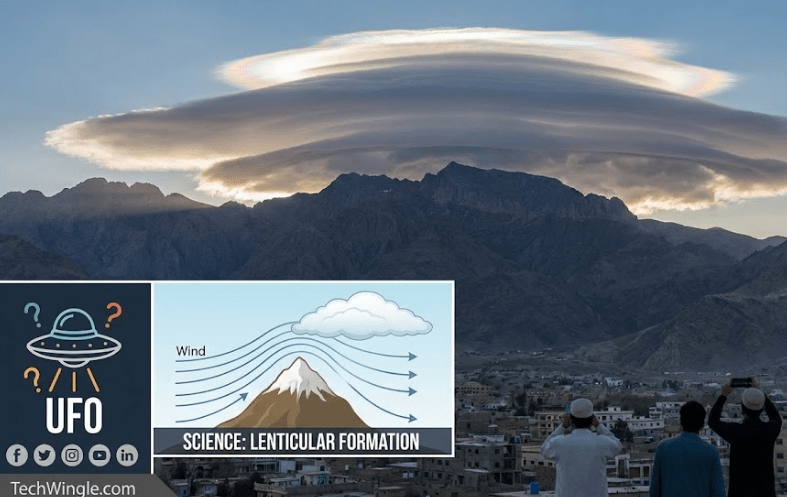
When people in Quetta woke up on Tuesday morning, they were a little surprised to see this sight in the sky. Many Christians on social media suggested that this cloud formation was the result of a missile test or some new technology being tested by the army. Later, the Pakistan Meteorological Department stated in a post that this phenomenon was a lenticular cloud formation seen early in the morning over the Koh-e-Murdar area.
They reported that these clouds appeared before sunrise, persisted for about 20 minutes, and disappeared just before sunrise. So, what are lenticular clouds? The name comes from the Latin word lenticular, meaning a very small lens. They are famous for their UFO-like appearance, which is why they sometimes cause trouble. The surprising thing is that they appear to stand still, even when there is strong wind.
Now you might be wondering how they form? These clouds are formed by mountains and the wind passing over them. When the wind blows, it hits the side of a large mountain and has to climb higher. As the wind rises, it cools down significantly. Cold air can no longer hold as much water vapor. The excess water vapor condenses into droplets, forming a small cloud at the top of the wave. The wind moves within the cloud, but the cloud itself remains in place. It’s like waves in a river. The water moves, but the wave stays put.
Viral Lenticular Clouds in Koh-e-Murdar, Quetta
On a quiet Tuesday morning in late October 2025, the residents of Quetta and surrounding districts in Balochistan woke up to a sight that seemed plucked straight from a high-budget science fiction film. A glowing, multi-colored, saucer-shaped object hung motionless over the Koh-e-Murdar mountain range, sparking an immediate firestorm on social media.
While local rumors ranged from secret military missile tests to extraterrestrial visitations, the reality was a rare masterclass in atmospheric physics. Today, we break down the “what,” “how,” and “why” behind this mesmerizing event.
The Morning the Sky “Stood Still”
The phenomenon began around 6:20 AM, just as the first light of dawn hit the eastern horizon. For approximately 20 minutes, a perfectly symmetrical, lens-shaped cloud hovered over the peaks. What made it particularly striking was its iridescence—a rainbow-like halo that made the cloud appear to glow from within.
The Conspiracy vs. The Clarification
In a region often associated with strategic military importance, the public’s first instinct was tactical. Theories of a hypersonic missile test or a “covert army technology” began to trend. Even high-level officials, when questioned by the media, initially sidestepped the technical details, which only fueled the mystery.
However, the Pakistan Meteorological Department (PMD) quickly stepped in to clarify: this was a textbook case of Altocumulus lenticularis, more commonly known as a Lenticular Cloud.
What Exactly Are Lenticular Clouds?
The word “Lenticular” is derived from the Latin lenticularis, meaning “lens-shaped.” These clouds are world-famous for their smooth, disc-like appearance, which has made them the primary suspect in thousands of “UFO” sightings globally for decades.
Why Do They Look Stationary?
Perhaps the most “tech-like” feature of these clouds is their inability to move with the wind. To the naked eye, they appear to be standing perfectly still, even when gale-force winds are blowing at high altitudes.
This happens because the cloud is a “standing wave.” Much like a wave in a river that stays in one spot even as the water flows through it, air particles move through a lenticular cloud, condensing on one side and evaporating on the other. The cloud itself remains fixed in space, acting as a visual marker of an invisible atmospheric wave.
The Engineering of Nature: How They Form
The geography of Quetta makes it a natural laboratory for these formations. Here is the step-by-step “system” that creates them:
-
The Obstacle (Koh-e-Murdar): Stable, moist air is pushed horizontally by strong winds. When it hits a massive barrier like the Koh-e-Murdar range, it has no choice but to go up.
-
The Cooling Phase: As the air climbs, it experiences adiabatic cooling. Because cold air cannot hold as much water vapor as warm air, the moisture begins to condense.
-
The Wave Crest: Once the air reaches the top of its “wave” (the crest), it forms a cloud.
-
The Evaporation Phase: As the air moves past the mountain and descends back down (the lee side), it warms up again, and the cloud droplets evaporate.
This cycle of condensation at the peak and evaporation at the trough creates the sharp, clean edges that give the cloud its “metallic” or “solid” look.
Why Was There a Rainbow Halo?
The “magical ring of colors” reported by Quetta residents was caused by a phenomenon called Cloud Iridescence.
When the sun is positioned at a specific angle (usually within 10–40 degrees of the cloud) during sunrise or sunset, its light hits the uniformly sized water droplets or ice crystals in the cloud. The light is diffracted—it bends and spreads out into its component colors, much like light passing through a prism or an oil slick on water. This created the “neon” effect that many mistook for a propulsion system or a glowing craft.
Conclusion: A Reminder of Nature’s Complexity
The Quetta sky event of 2025 serves as a powerful reminder of why scientific literacy is crucial in the digital age. While it is tempting to jump to “high-tech” or “otherworldly” conclusions, the laws of physics usually provide a much more elegant explanation.
At TechWingle, we believe that understanding the systems of our planet is just as important as understanding the systems of our computers. The next time you see something “impossible” in the sky, remember the standing waves of Koh-e-Murdar.
FAQ: Quetta’s Mystery Sky
Q: Are Lenticular Clouds dangerous?
A: To people on the ground, no. They are perfectly harmless. However, for pilots, they are a major warning sign of “Mountain Wave Turbulence”—extremely strong updrafts and downdrafts that can be dangerous for smaller aircraft.
Q: Can these happen in other cities like Karachi or Lahore?
A: It is highly unlikely. These clouds require high-altitude mountains to trigger the initial wave. Since Karachi and Lahore are largely flat, they lack the “geographical trigger” needed for lenticular formations.
Q: Why don’t we see them every day in Quetta?
A: They require a very specific “recipe”: the wind must be blowing at a certain speed perpendicular to the mountain, the air must be stable, and the humidity levels must be exactly right. If the air is too dry, no cloud forms; if it’s too turbulent, the shape is lost.
Sources:
- The News International Quetta News – Pakistan Meteorological Department (PMD) Official Statement.
- BBC Urdu – Scientific ( YT Video Explainer)
- Dawn Quetta News – Regional Atmospheric Reports 2025.